Stuff I’ve made
Club builds, class projects, research of my own, and a couple of things that are still only proposals. I’ve said which is which. Places I’ve actually worked are over on Work.
Hardware
-
Sawdawg: 12 lb Walker Combat Robot
2026 to nowMIT Combat Robotics, Exec Member
Chassis design on a 12 pound combat robot.
-
MASLAB Autonomous Robot
2026MIT Mobile Autonomous Systems Lab3rd place
Five of us built a robot from nothing in under a month. It found its own way around the arena using computer vision, and stacked cylinders with a belt drive mechanism. I worked on mechanical design, manufacturing, and electronics. We came 3rd in the class competition.
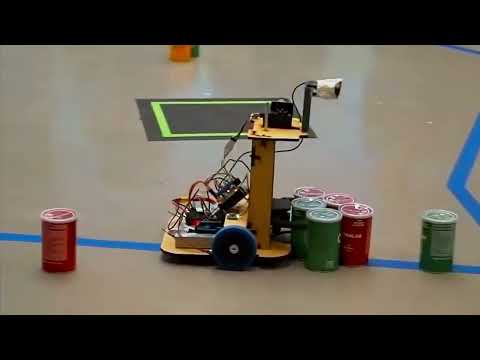 MASLAB 2026 Competition Highlights
-
Formula Car Lap Timer Mount
Sep to Dec 2025MIT Motorsports, Chassis and Testing
Worked on a lap timer mount to improve telemetry. Soldered and did design work.
-
YUUMI: Drone Sensing for Steel Reuse
2026early stage proposal
A drone that carries RGB and temperature sensors alongside hyperspectral imaging, so structural steel can be surveyed and reused rather than scrapped. Routing algorithms decide where it flies. I’m leading the technical side and we’re working toward an MVP. Nothing is built yet.
-
Science Olympiad Build Devices
2022 to 2025
Devices for the build events. Deterministic robot built on Arduino and C++, built in a team environment.
Software
-
Steel Lifecycle Mapping
2023 to 2026NYU Urban Modeling Lab
Structural steel gets scrapped and melted down when a lot of it could simply be reused. I mapped where American steel actually comes from and where it goes: mills, fabricators, recyclers and ports laid over the road and rail network, with each project sized by cost. On top of that I wrote a multiple origin, multiple destination router based on Dijkstra’s and ran it across 2,500 data points. Sending steel straight from one project to the next came out around ten miles, against hundreds of miles for the trip through a recycler. An abstract from this work was accepted to IABSE 2026.
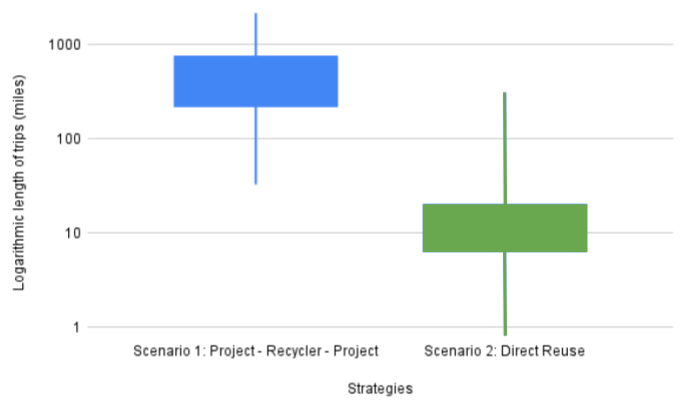
Routed trip lengths on a log scale. Going project to recycler to project runs into the hundreds of miles. Direct reuse between projects sits near ten. -
Phantom Traffic Jam Detection
sole author research
Traffic jams that form with no crash or bottleneck causing them are hard to see coming. I built Bayesian networks to catch them in the US DOT’s NGSIM trajectory data. After clearing out outliers and binning the features, the best models cleared 90 percent on every metric, with accuracy and recall both just under 94.
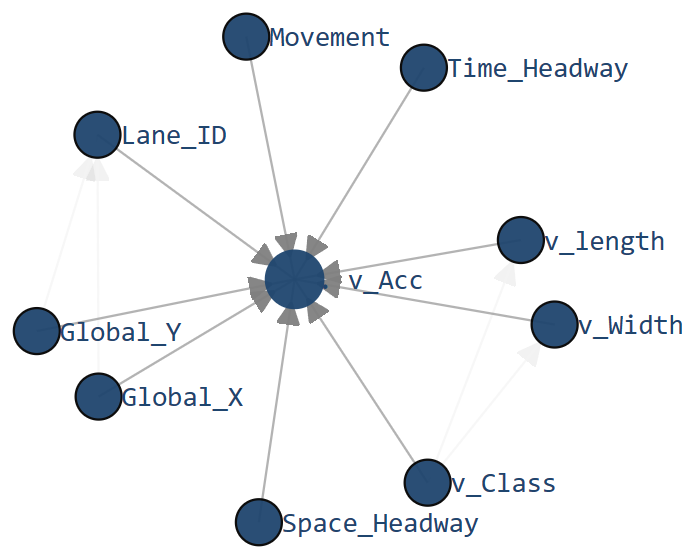
The learned network over NGSIM trajectory variables, all conditioning acceleration. 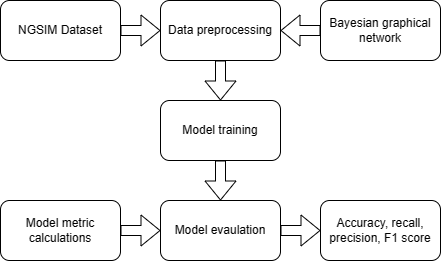
The pipeline: NGSIM data and a graphical network feed preprocessing, training, then evaluation. -
Construction Injury Prediction
2023NJIT SCIIS Lab
Construction sites hurt people in ways that look predictable once you have enough records. I built Bayesian network models over 4,847 OSHA incident reports that predict whether an incident turns out fatal. I vectorised the incident text, clustered it, stripped the outliers, then bagged a naive network and a tree augmented one into an ensemble. It hit 92.0 percent accuracy and 91.1 percent recall.
The accuracy is not the interesting part. It ranks fifth of the seventeen studies I tabulated, and the four above it are all black boxes. On a real site a model that tells you which factors drove the call is worth more than one a fraction of a point better that cannot explain itself. I read and tabulated about thirty papers to work that out.
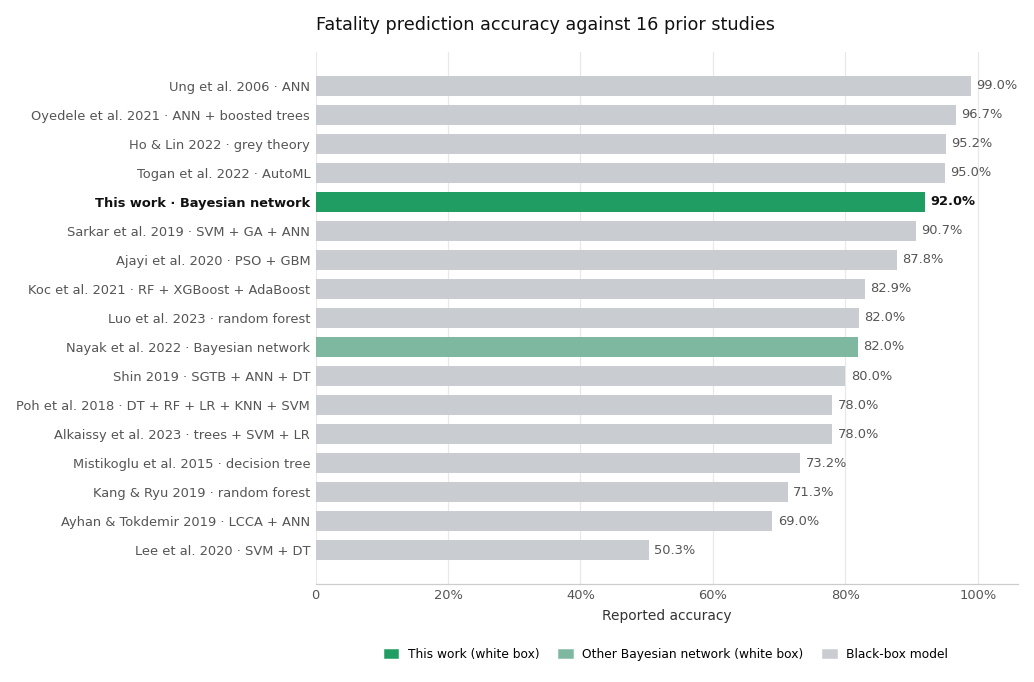
Accuracy against the sixteen prior studies in my literature table that reported it. The four above are black box models. The only other Bayesian network sits ten points lower. 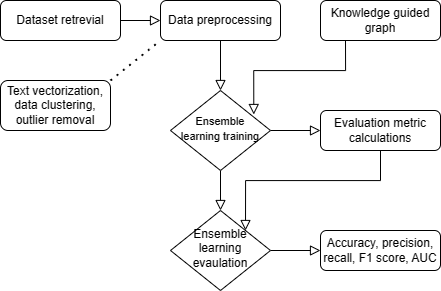
The method: retrieve the OSHA data, vectorise and cluster the text, strip outliers, then train an ensemble guided by a knowledge graph. -
LEO Satellite Commands and Data Handling
2026 to nowMIT Satellite Team
I’m writing the low level communication procedures for a satellite that will test a new kind of propellant mixing baffle in low Earth orbit.
-
AOVS: Variable Speed Limits
2024research proposal
A proposal to set freeway speed limits with machine learning you can actually interpret, using Bayesian networks and white box LSTMs trained on NGSIM data and checked in a traffic simulator.
-
2D vs 3D Reaction Time Study
2022
A class experiment with 16 people, comparing how quickly they reacted in a 2D aim trainer against a 3D one. A two sample t test found no real difference between them.


